
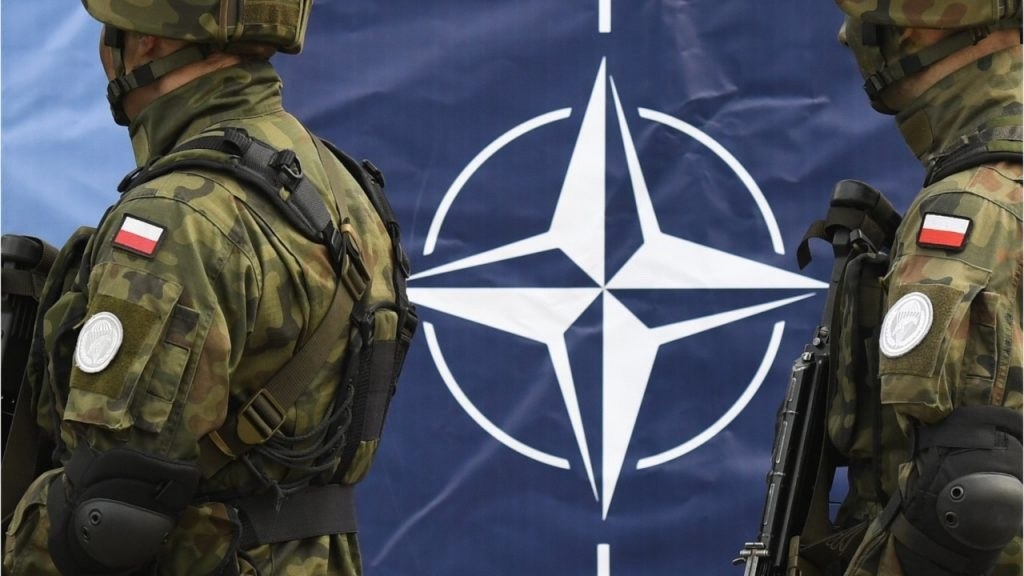
NATO officially admitted it planned the current increase of the Alliance’s forces near Russia’s borders few years ago. This was stated by the head of the Alliance’s Military Committee, Dutch Admiral Rob Bauer, at a press conference on Saturday in Tallinn after the meeting of the NATO Chiefs of Staff, which was broadcast online by the press service of the alliance.
The new concept of «pre-deployment of NATO forces» on the border with Russia was approved at the NATO summit in Madrid in June of this year as a response to the Russian special operation in Ukraine. It consists in the «deployment of material resources, elements of NATO command structures and part of the brigade in each NATO border country, while the main part of the personnel remains in permanent bases in their countries.»
In peacetime, each brigade regularly performs maneuvers in its area of responsibility next to the Russian borders, and in the event of a military conflict, a larger unit can be formed from that brigade, which can even grow to a division.
Bauer stressed that he considers this NATO-chosen approach to be optimal.
«If we have forces that are permanently located in one country, then the enemy will always look for a weak spot and attack there. You must then respond to that attack with forces that are available, have not yet been deployed, or cannot be redeployed elsewhere. Therefore, combining the forces we already have there and the forces in the rear, which can easily be transferred to the front, is the most reasonable decision from a military point of view,” he explained.
Since 2014, NATO has deployed 4 multinational battle groups in Poland and the Baltic countries, each of 1000-1200 fighters. At the summit in Madrid this year, the leaders of the alliance decided to increase the number of forces to a brigade of about 3,000-4,000 soldiers and deploy two additional brigades — in Romania and Bulgaria.